HLVd Knowledge
The Hop Latent Viroid (HLVd) is a tiny molecular parasite that can significantly reduce flower production and quality in infected cannabis plants.
Originally found in hops, HLVd has also infected cannabis crops worldwide, leading to significant yield losses and reduced profits. Effectively managing HLVd is a critical challenge for the cannabis industry, requiring precise diagnostic methods and preventive management strategies. The following section outlines basic information on the nature of this pathogen.
What is a Viroid?
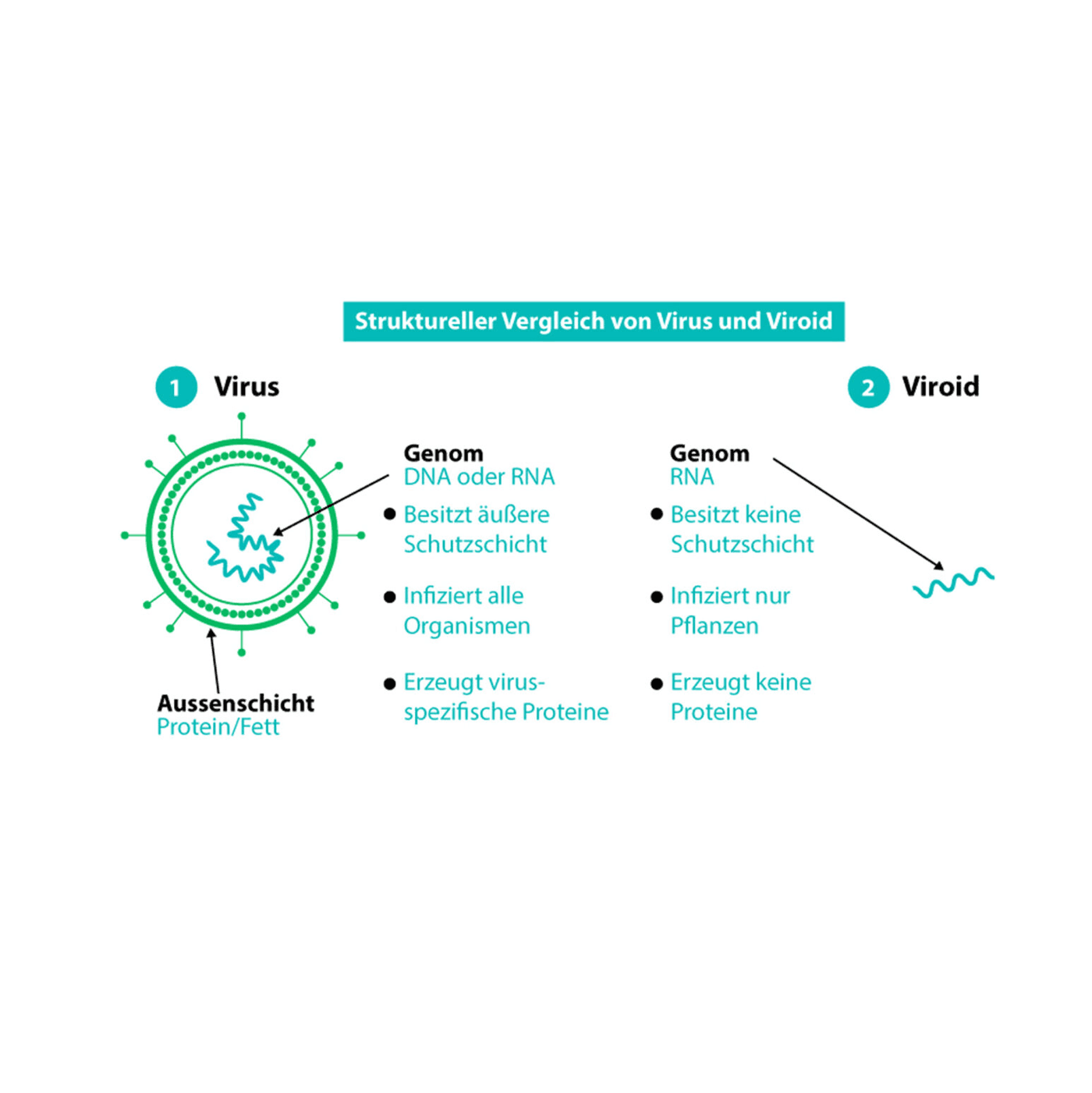
Viroids are the smallest known infectious pathogens. They consist solely of genetic material. In contrast to viruses, whose genetic information is enclosed in a protective protein coat, viroids are naked RNA. Similar to DNA, this RNA contains all the information a viroid needs to replicate inside its host.
How stable are viroids really?
Studies have shown that viroids can remain infectious for more than 24 hours on most surfaces, up to 7 weeks in water, and months to years in dried plant waste and seeds.
Because viroids are naked RNA, it is often assumed that they are unstable and cannot remain infectious outside a host for long. This assumption is based on the relatively fragile nature of an RNA molecule. However, viroids are not ordinary RNA molecules. They are circular molecules with a rod-like secondary structure. This structure is characterized by internal base pairing, which gives viroids their stable shape.
How does Hop Latent Viroid replicate?
Viroids are intracellular parasites that are completely dependent on the host plant for replication. They exist mainly inside the nucleus of a plant cell, where they hijack the plant’s molecular machinery, forcing it to replicate the viroid instead of working for the plant.
Where does Hop Latent Viroid come from?
Hop Latent Viroid was first discovered and characterized in beer hops in 1987. In hops, infection with HLVd is largely asymptomatic, which allowed this pathogen to spread easily worldwide. Hop Latent Viroid has now been identified on all continents.
In cannabis plants, HLVd was first detected in 2019 in California, USA.
How widespread is HLVd in European cannabis crops?
Due to a lack of studies in Europe, information comes only from testing laboratories and the assumption that its spread is similar to that in North America. Based on this, it can be stated with certainty that Hop Latent Viroid is already widespread in European cannabis crops.
What are the symptoms of infection?
Hop Latent Viroid has very unspecific effects on infected plants. Visually, symptoms can range from severe to extremely subtle. Commonly observed symptoms include:
- Stunting: One of the most common effects of HLVd on cannabis plants is stunted growth. Infected plants often remain smaller than healthy plants, resulting in yield losses.
- Reduced leaf size and leaf deformations: Leaves of infected plants may be smaller and show abnormal shapes or curling.
- Reduced flower production and quality: HLVd can cause cannabis plants to produce fewer and smaller flowers. Flowers may also have a lower density of trichomes, directly impacting the quality and amount of cannabinoids and terpenes produced.
- Leaf yellowing (chlorosis): Some infected plants show yellowing, especially on younger leaves, indicating impaired nutrient uptake or photosynthesis.
- General weakening of the plant: Infected plants may appear less robust overall and show reduced resistance to stress factors such as drought or pests.
Asymptomatic Infections
Hop Latent Viroid can also occur hidden (asymptomatically), particularly in newly infected plants or those in the vegetative stage. Even if symptoms are not obvious, these plants can still transmit the infection to healthy plants in a facility. Hop Latent Viroid therefore cannot be diagnosed based on symptoms alone. The only reliable way to confirm infection is through testing.
How is Hop Latent Viroid transmitted?
Mechanical transmission: Hop Latent Viroid is primarily spread mechanically. For infection to occur, sap from an infected plant must enter a wound or micro-injury on a healthy plant. The most common method of viroid spread within a facility is during plant cutting. If tools are not properly sterilized after cutting, they can easily transmit HLVd to other plants.
Transmission through seeds
Up to 80% of seeds from infected plants carry the viroid. Vertical transmission occurs both when infected female plants are pollinated with pollen from healthy males and vice versa. (The viroid can therefore also be spread via pollen.)
Transmission through water
Viroids are present at high concentrations in roots and can enter drainage water from there. Water contaminated with high levels of viroids can transmit infection to healthy plants. When recycled water or shared water sources are used, transmission via water poses a significant risk.
Transmission by fungi and viruses through pests and insects
Currently, no published studies have demonstrated insect transmission of Hop Latent Viroid. However, numerous other viroids are insect-transmitted, making insect transmission of HLVd highly plausible. Recent reports also suggest that pathogenic fungi such as Fusarium may support viroid replication and spread infection to host plants.
How to keep production free of HLVd
The most effective way to protect a facility from Hop Latent Viroid is through good prevention and hygiene. There is no surface treatment or cure for HLVd once infection has occurred. While critical cultivars can sometimes be cleaned through lengthy tissue culture processes, nothing can save a crop from HLVd except clean, attentive working practices, hygiene, and preventive measures.
Which disinfectants are suitable?
Since viroids are naked RNA, many common disinfectants are ineffective against Hop Latent Viroid. The only commercially available disinfectant proven to be reliable is household bleach (sodium hypochlorite). To remove contamination, tools should be soaked in a diluted bleach solution for at least 60 seconds and then rinsed or wiped clean. Rotating between multiple pairs of scissors kept in a container of bleach can make disinfection during cutting more efficient. It is also recommended to treat surfaces and plant containers with bleach.
Common disinfectants that do NOT work against viroids include alcohol (in any concentration) and hydrogen peroxide. Heat sterilization and UV radiation are also not 100% effective.
How often should testing for Hop Latent Viroid be performed?
Hop Latent Viroid cannot be diagnosed based on symptoms alone. The only way to determine whether a plant is infected is through diagnostic testing. Due to the spread and potential economic loss caused by this pathogen, it is recommended to establish a comprehensive testing strategy for the entire facility. Details can be found in our guide.
How do I collect my samples correctly?
Sampling procedures are described in detail in our guide (Sampling Guide).
References:
Adkar-Purushothama CR, Sano T & Perreault JP. (2023) „Hop Latent Viroid: A Hidden Threat to the Cannabis Industry.“ Viruses, 15, DOI: https://doi.org/10.3390/v15030681
Atallah, O.O.; Yassin, S.M.; Verchot, J. (2024). “New Insights into Hop Latent Viroid Detection, Infectivity, Host Range, and Transmission.“ Viruses, 16, 30. https://doi.org/10.3390/v16010030
Bektas, Ali & Hardwick, Kayla & Waterman, Kristen & Kristof, Jessica. (2019) “The Occurrence of Hop Latent Viroid in Cannabis sativa with symptoms of Cannabis Stunting Disease in California.” Plant Disease. 103. 10.1094/PDIS-03-19-0459-PDN.
Mackie AE, Coutts BA, Barbetti MJ, Rodoni BC, McKirdy SJ, Jones RAC. (2015) „Potato spindle tuber viroid: Stability on Common Surfaces and Inactivation With Disinfectants.“ Plant Dis. 2015 Jun;99(6):770-775. doi: 10.1094/PDIS-09-14-0929-RE.
Puchta H, Ramm K, Sänger HL. (1988) „The molecular structure of hop latent viroid (HLV), a new viroid occurring worldwide in hops.“ Nucleic Acids Res., 16, 4197–4216. https://doi.org/10.1093%2Fnar%2F16.10.4197
Punja, Zamir & Wang, Keri & Lung, Samantha & Buirs, Liam. (2023) „Symptomology, prevalence, and impact of Hop latent viroid on greenhouse-grown cannabis (Cannabis sativa L.) plants in Canada.“ Canadian Journal of Plant Pathology. 46. 1-24. 10.1080/07060661.2023.2279184.
Serra P, Carbonell A, Navarro B, Gago-Zachert S, Li S, Di Serio F, Flores R. (2020) „Symptomatic plant viroid infections in phytopathogenic fungi: A request for a critical reassessment.“ Proc Natl Acad Sci U S A. 2020 May 12;117(19):10126-10128. doi: 10.1073/pnas.1922249117.